RSTS
The Early Days
Order Number: XX-857E8-FB
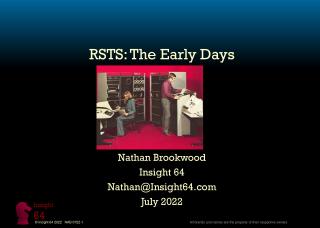
This document provides a historical overview of the RSTS (Resource Sharing Time Sharing) operating system, largely from the perspective of Nathan Brookwood, its initial project leader. It details his career leading up to and beyond RSTS, beginning with his work on TSS/8 and PDP-11 marketing at DEC.
The presentation outlines the predecessors to RSTS, including DEC's TSS/8 and HP-2000A, noting their limitations in memory, disk capacity, and suitability for commercial tasks. The original RSTS development team was small, with Brookwood responsible for the OS and drivers. The product was initially named BTSS (Basic Time Sharing System) but was renamed RSTS after a trademark conflict. A crucial component, Basic-Plus, was developed by the three-man software company EG&H for $30,000, a project that helped them thrive for over 20 years.
After Brookwood moved to marketing in early 1973, Mark Bramhall and then Jackie Pakarinen took over RSTS/E development, expanding its capabilities to include quadrupled main memory support (128KB), hardware floating point, an expanded file system, and multi-language support. The evolution of RSTS progressed from an unreleased Version 1, to Version 2 (the first "high-volume" release known for auto-restart but also "catastrophic errors"), and Version 3 (introducing record I/O and being the last non-memory mapped version). Early RSTS customers included educational institutions and commercial entities like Continental Can and Prudential Life Insurance.
Brookwood's career continued into software engineering, where he led DECnet and PrimeNet strategies and coordinated CT-Net. He concludes with a reflection, noting that he didn't fully appreciate DEC's strengths, such as its willingness to empower inexperienced managers, until after he left, and that its flexible process was both a strength and a weakness.
Site structure and layout ©2025 Majenko Technologies