Software Specification for KA630-A Console Program
Order Number: MISC-68409AEF
- / Hardware / Computers / VAX / VAXstation II/GPX
- / Hardware / Computers / VAX / MicroVAX II
- / Hardware / Components / CPU / VAX / KA630
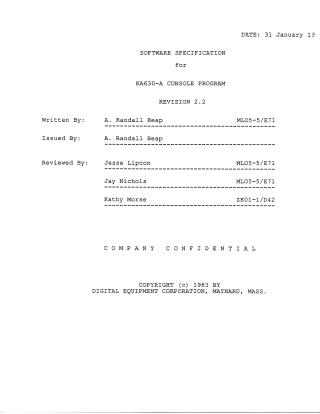
This document is a Software Product Specification (Revision 2.2) for the KA630-A Console Program, dated January 31, 1985, by Digital Equipment Corporation.
It serves as the definitive description of the KA630 console program's goals, capabilities, and external characteristics, as agreed upon by the product team. The program, which resides in ROM on the KA630 processor board, gains control whenever the KA630 hardware "halts."
Key functionalities and aspects detailed in the document include:
- Core Services: Providing automatic restart or bootstrap following processor halts or initial power-up, offering an interactive command language to examine and alter processor state, performing diagnostic tests on CPU, memory, and Q22-bus map, and supporting various terminal types (video, hardcopy, and bitmapped).
- Target Users: Engineering, Manufacturing, Field Service personnel, and customers, who use the program to test, configure, boot systems, and detect/isolate malfunctions. The design considers both sophisticated and unsophisticated users.
- Internationalization: Console messages are available in multiple languages (English, French, German, Spanish, Italian, Norwegian, Dutch, Swedish, Finnish, Danish, Portuguese), with the preferred language stored in battery-backed RAM.
- Software Capabilities: Detailed descriptions of power-up sequences (including ROM checksums, memory initialization, battery backup checks, terminal determination, and language selection), diagnostic procedures and their output via LEDs and console messages, the restart algorithm (using a Restart Parameter Block), and the bootstrap process (Primary Bootstrap Program - VMB, and Secondary Bootstrap, supporting various devices like disk, tape, PROM, and Ethernet).
- Console I/O Mode: Defines the command language syntax (e.g., BOOT, CONTINUE, DEPOSIT, EXAMINE, HALT, TEST, UNJAM) and control characters used when the system is halted.
- Product Characteristics: Covers aspects like packaging (ROM on processor board), ease of use, performance (e.g., command response time within 1 second), reliability (categorizing user, hard, and catastrophic errors), maintainability (ROM replacement), compatibility with DEC standards, and evolvability (limited due to ROM but with support for new compatible devices).
- Constraints and Tradeoffs: Outlines development priorities, including time to market, reliability, diagnostic coverage, memory consumption, and console I/O language complexity.
The document also includes appendices detailing LED and console display code interpretations, I/O registers used by the console program, and outstanding issues.
Site structure and layout ©2025 Majenko Technologies