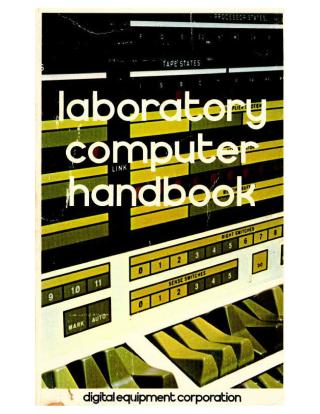
Laboratory Computer Handbook
Order Number: XX-353A2-AC
The "Laboratory Computer Handbook," published by Digital Equipment Corporation around 1971, serves as a comprehensive guide to the PDP-12 computer system, highlighting its versatility and utility across diverse scientific and educational laboratory environments. The PDP-12 is presented as a powerful and flexible 12-bit machine capable of operating in both LINC and PDP-8 modes, making it suitable for a broad spectrum of tasks from data acquisition and analysis to experimental control and teaching.
The handbook meticulously details the PDP-12's hardware architecture, including its central processor, memory (expandable from 4K to 32K words), and extensive input/output capabilities with various peripherals and interfaces such as LINCTape, CRT display, analog inputs, and a range of optional I/O devices. It emphasizes the system's ease of use and flexibility, enabling researchers to experiment with diverse data handling techniques without requiring extensive programming expertise.
Key applications of the PDP-12 are thoroughly covered in dedicated chapters, demonstrating its applicability in:
- Biomedical Systems: For tasks like signal averaging, time interval histograms, and signal editing in neurophysiological data analysis.
- Chemistry Systems: Utilizing the PDP-12 for analytical instrumentation control, floating-point processing, mass spectroscopy, and specific application software.
- Industrial Systems: Supporting process monitoring, quality control, and data acquisition in various industrial research settings.
- Clinical Laboratory Systems: Managing patient data, test processing, and administrative functions in hospitals and universities.
- Physics Applications: Illustrating its use in experiments such as pulse height analysis.
The document also outlines the PDP-12's role in Educational Systems, supporting the teaching of computer technology and programming through high-level languages like BASIC, FORTRAN, and FOCAL. Furthermore, it delves into the operational aspects of the PDP-12, covering programming modes, instruction sets, real-time clock functionalities, and detailed descriptions of system software like the LAP6-DIAL operating system and various utility programs and monitor commands designed for specific laboratory tasks.
Overall, the handbook underscores Digital Equipment Corporation's pioneering efforts in providing accessible and flexible computer solutions, positioning the PDP-12 as an integral tool for advancing scientific research and education.
Site structure and layout ©2025 Majenko Technologies