GIGI Terminal Set-Up Reference Card
Order Number: EK-VK100-RC
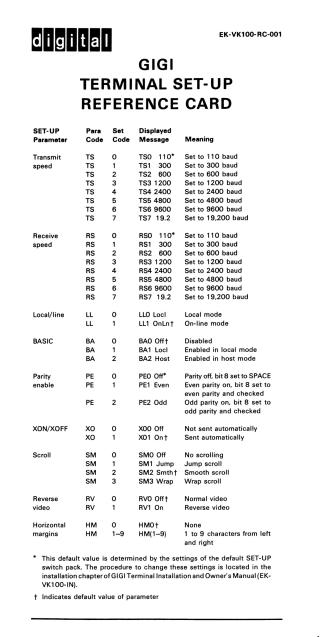
This "GIGI TERMINAL SET-UP REFERENCE CARD" (EK-VK100-RC-001), published in September 1980, serves as a comprehensive guide for configuring the GIGI terminal.
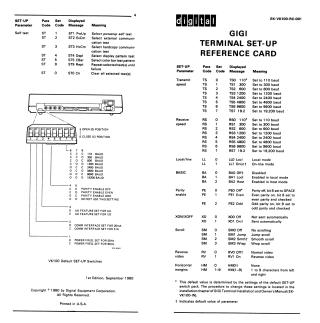
The document presents a series of tables, each detailing a "SET-UP Parameter" with its corresponding "Para Code," "Set Code," "Displayed Message," and "Meaning." These parameters allow users to customize various aspects of the terminal's operation, including:
- Communication Settings: Transmit and receive speeds (baud rates from 110 to 19,200), parity enable (off, even, odd), XON/XOFF flow control, communication interface type (EIA or 20mA), and hardcopy speed.
- Display Settings: Horizontal and vertical margins, expansion mode (normal or double-width characters), horizontal display position, overstrike behavior (replace or overlay), visual cursor type (off, text, graphics, both), text and graphics display rendering options, reverse video, and various scrolling modes (none, jump, smooth, wrap).
- Operational Behavior: Auto wraparound, key repeat, keyclick, margin bell, terminal emulation modes (VT52, ANSI), keypad and cursor key modes, programmed keypad, tablet locator mode, local echo, new line behavior, and auto hardcopy.
- System Configuration: UK/US character set and power frequency (50Hz/60Hz).
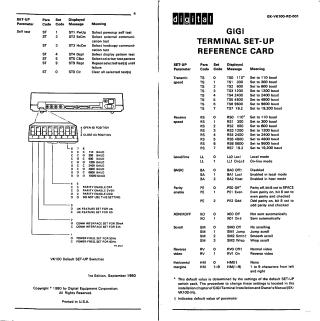
- Self-Tests: Options for power-up, external communication, hardcopy communication, display pattern, color bar, and repeating tests.
The document also notes that certain default values are determined by settings on a physical SET-UP switch pack (DIP switches). A detailed diagram on the last page illustrates the configuration of these switches for primary settings like baud rate, parity, character set, and communication interface.
Site structure and layout ©2025 Majenko Technologies