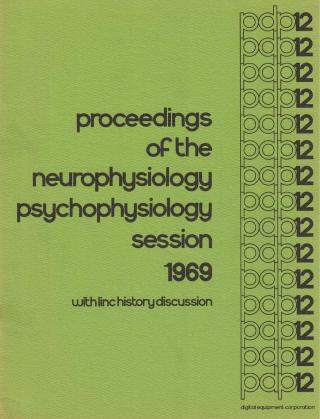
Proceedings of the Neurophysiology-Psychophysiology Session, 1969
Order Number: XX-88038-45
This document compiles the proceedings of the 1969 Spring DECUS Biomedical Symposium, focusing on the applications and evolution of LINC-class computers (LINC, LINC-8, and PDP-12) in neurophysiology and psychophysiology.
The foreword introduces the LINC as a powerful, interactive, real-time experimental tool, developed through the ingenuity of individuals like Wesley Clark and Mary Allen Wilkes, and supported by Digital Equipment Corporation (DEC). Early history and design philosophy, emphasizing accessibility and direct user interaction, are discussed, along with a comparison of the classic LINC to the LINC-8 and PDP-12, highlighting improvements in memory, speed, A-D converter accuracy, display size, and the integration of PDP-8 compatibility for enhanced performance and economic viability.
The proceedings detail three specific research applications:
- Neuroelectric Potentials: The LINC is used to study behavioral correlates of evoked neuroelectric potentials (SER and CNV) in the brain. The system manages complex, real-time data acquisition, stimulus presentation, and response recording, utilizing digital magnetic tape and punched paper tape to overcome memory limitations for data storage and analysis.
- Family Membership Experiences: The LINC automates procedures for assessing family interactions in schizophrenia. It controls multiple teletypes to administer problem-solving tasks and record responses across various information-sharing modes, standardizing the experimental process and significantly reducing the need for human experimenter intervention.
- Biologic Rhythms (Quantitative Chronobiology): The LINC-8, running a "MONTOR" software system, is applied to the quantitative study of biologic rhythms. It collects and analyzes both fast and slow rhythms, makes real-time experimental decisions (e.g., for drug administration), and demonstrates its versatility in operating simultaneously in batch, process control, and interactive modes.
A discussion section explores new PDP-12 software (DIAL System), the evolution of LINC's I/O interfaces, challenges in sharing software among users, and a comparative analysis with larger process-control computers. It concludes that LINC-class machines are particularly well-suited for direct, flexible laboratory research due to their user-centric design, often outperforming more complex, protected process-control systems for experimental tasks.
Site structure and layout ©2025 Majenko Technologies